


Equinix expands Fabric Geo Zones across five continents
Fri, 15th May 2026
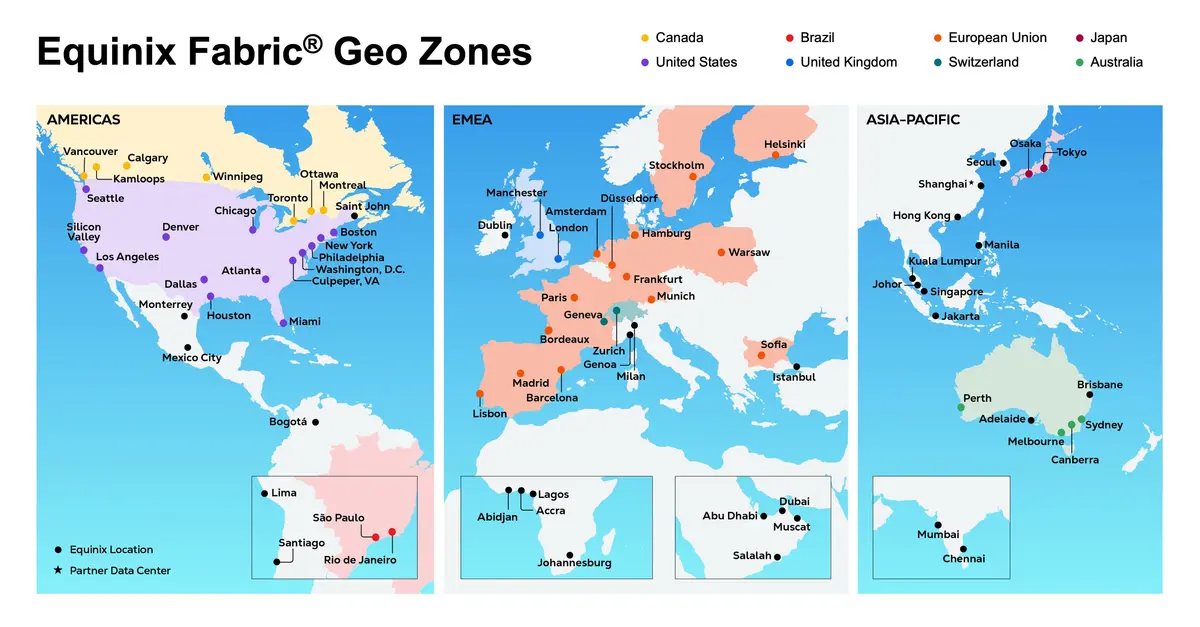
Equinix has expanded its Fabric Geo Zones service across five continents, including Australia and Japan, to give customers more control over where data travels across hybrid and multi-cloud networks.
The expansion extends what Equinix describes as a network-level way to enforce geographic boundaries for data flows between clouds and providers. It is designed to address situations where rerouting during outages, failover events or congestion could send sensitive data across borders that organisations are legally or contractually required to avoid.
Built into Equinix Fabric, the group's software-defined network spanning 77 metropolitan markets, Fabric Geo Zones lets customers define geographic limits for traffic moving across hybrid and multi-cloud environments. Traffic stays within those boundaries, or is blocked if no compliant route is available.
The issue is becoming more pressing for companies operating under overlapping data and privacy rules in different jurisdictions. Businesses in government, financial services and healthcare face tighter requirements on where data can be stored, processed and transmitted.
Courtney Munroe, founder of Apex Research, said the compliance burden has become harder for global companies to manage as they adopt new technologies across multiple markets.
"Businesses are facing one of the most complex global regulatory environments in history while at the same time facing huge pressure to deploy new technologies," Munroe said.
"A global enterprise operating under GDPR in Europe, LGPD in Brazil, and APRA in Australia simultaneously needs different data routing rules for each jurisdiction, with every outage, failover, or congestion event a potential compliance violation. With Fabric Geo Zones, Equinix is delivering a foundational solution that is truly built from the ground up with native sovereignty controls at its core, giving enterprises confidence to operate in a globally fragmented regulated environment."
Network control
Equinix is positioning the service as different from products that sit inside a single cloud platform or operate as software overlays above network infrastructure. By placing controls at the network layer, it argues, policy can be applied across multiple clouds, providers and routes rather than within a single platform.
Arun Dev, vice president of digital interconnection at Equinix, said sovereignty rules need to apply across the full path taken by traffic.
"Sovereignty can't be a setting you configure inside a single cloud. Global enterprises must enforce sovereignty at the network layer, across every cloud, provider and path simultaneously," Dev said.
"Equinix Fabric Geo Zones is the only solution that enforces geographic boundaries as a property of the network itself. Traffic either flows along compliant paths or it's blocked. That's why enterprises across industries trust Equinix to move data across clouds without compromising sovereignty."
The preview is available in Equinix markets including Australia, Brazil, Canada, Japan, Switzerland, the UK and the US. It is offered as a premium tier, included in the Unlimited Ports and Unlimited Ports Plus packages, and priced above standard virtual circuits.
Assurance questions
Alongside routing controls, the expansion also highlights a broader issue in sovereign connectivity: proving that security and compliance requirements are being met in each country. In Australia, Equinix Fabric has undergone an IRAP assessment aligned with the Australian Government Information Security Manual, which may matter to public sector bodies and regulated industries assessing suppliers.
That combination of route enforcement and independent security assessment is likely to matter in markets where customers want both technical controls and external assurance. For many buyers, especially in highly regulated sectors, data residency is not only about whether traffic stays within a boundary, but also whether the infrastructure handling it meets local security expectations.
Equinix said the service is intended for situations where compliance must be built into everyday network operations. Examples include financial institutions keeping transaction data within the EU during outages, healthcare providers retaining patient and AI inference data within set jurisdictions, and government agencies confining sovereign AI workloads to national or regional boundaries.
The expansion also fits into Equinix's broader networking and AI strategy, following the introduction of Fabric Intelligence and the Distributed AI Hub. Those launches suggest a wider effort to make its interconnection network more central to how customers link clouds, data and AI workloads across multiple locations.
Fabric Geo Zones is available in preview across Equinix's global footprint, including Australia, Brazil, Canada, Japan, Switzerland, the UK and the US.