

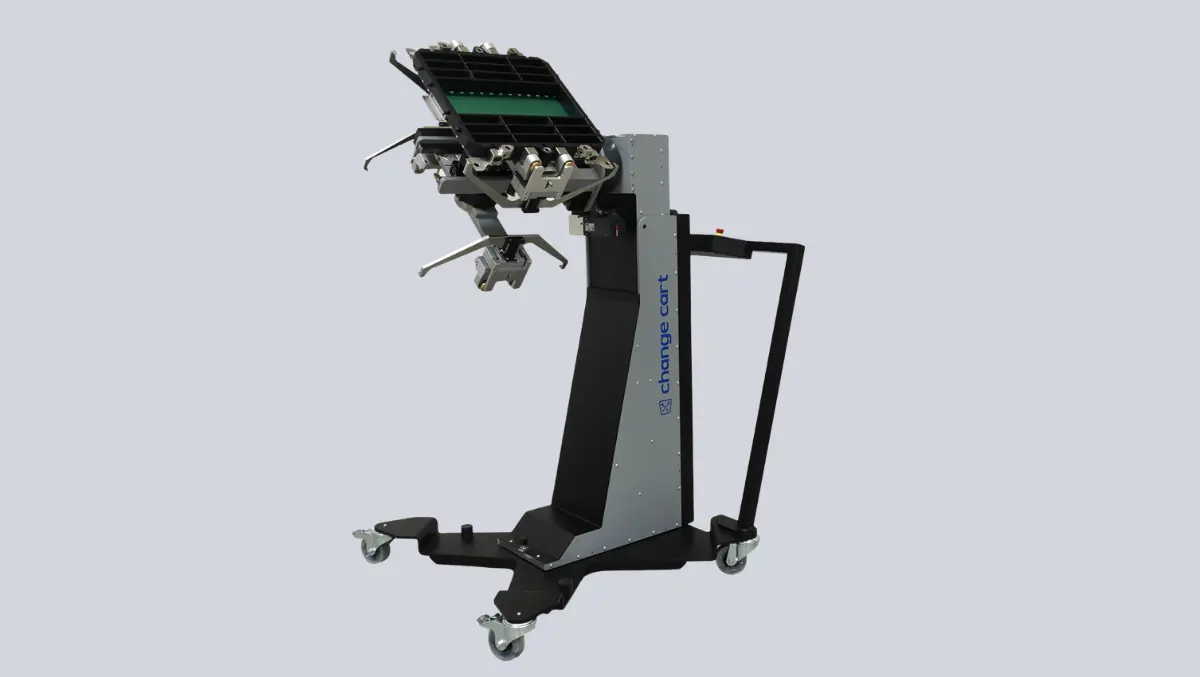
Esmo launches X-change Cart for faster board changes
Thu, 7th May 2026
esmo Group has launched the X-change Cart for handling load boards on semiconductor test floors. The system is designed to let one operator complete a board change in under one minute.
The launch addresses a routine task in high-mix semiconductor testing, where frequent load board changeovers can slow operations and increase the risk of damage to expensive boards.
The X-change Cart is a semi-automated Device Interface Board exchange system designed to replace manual load board movement on the test floor. It uses a structured process controlled through a human-machine interface, allowing an operator to lock, rotate and transfer a board to a tester.
The cart can carry two boards in a single trip, supporting the claimed changeover time. It also includes a locking mechanism with up to 180-degree rotation and a tower swivel of up to 90 degrees, helping staff work in tighter spaces on the production floor.
Test floor
The product enters a part of semiconductor manufacturing where small delays in test handling can affect overall throughput. In outsourced semiconductor assembly and test facilities, as well as at integrated device manufacturers, test floors often run a mix of products that require repeated board changes across different handlers and testers.
That has created demand for tools that reduce manual lifting and standardise repetitive tasks. Load boards and related interface hardware can be high-value components, and repeated handling raises concerns about accidental damage as well as operator strain.
"Across test floors, we kept seeing the same pattern," said Josef Weinberger, Head of Business Unit, esmo semicon. "Board changeovers were slow, physically demanding, and too dependent on individual technique. In tight spaces, that's where mistakes happen and time is lost. That observation drove us to build a dedicated solution that makes changeovers fast, repeatable, and manageable by a single operator in under a minute."
Platform support
The X-change Cart is compatible with several automated test equipment platforms, including systems from Teradyne, Advantest and SPEA. That compatibility is aimed at semiconductor test sites that already operate tools from more than one supplier and want to add handling equipment without changing their wider setup.
The cart can interface with the test head, prober, DIB-loader, storage rack and maintenance workbench. It also includes sensor detection, a safety hand brake and a modular battery.
For customers looking to automate more of their test floor operations over time, the system can also be configured with its interface tower mounted on a customised automated guided vehicle or autonomous mobile robot. The modular design also allows additional functions to be added as requirements change.
The announcement reflects a broader push in semiconductor manufacturing to automate handling tasks that have remained partly manual even as production tools themselves have become more sophisticated. Companies across assembly, packaging and test have been under pressure to improve consistency, reduce labour-intensive steps and make better use of floor space.
Those demands have become more acute in high-mix environments, where product changes are common and equipment downtime linked to setup or reconfiguration can quickly add up. Suppliers in the test ecosystem have increasingly focused on tools that fit around existing installations rather than requiring wholesale hardware replacement.
esmo, founded in 2001, operates as an engineering and automation supplier across several industries. Its semiconductor unit focuses on manipulators, docking and interfacing components, and handling systems. The group is a subsidiary of Accuron Industrial Technologies.
Weinberger said reliability was a central part of the product design. "Reliability in production comes down to the details. The gripper head is engineered to perform consistently under real production conditions, with ESD-safe construction ensuring the board is protected at every point of contact. That level of engineering discipline is what makes the difference on a real production floor."