

WD maps 100TB-plus hard drives for AI data centres
Wed, 4th Feb 2026
Western Digital has rebranded as WD and laid out a multi-year product roadmap centred on higher-capacity hard disk drives, higher-throughput designs, and lower power consumption for AI and cloud customers.
WD says it has a clear path to hard drives exceeding 100TB by 2029, with a 40TB model already in qualification with hyperscale customers. It also outlined new drive architectures to boost bandwidth and input/output performance, along with a separate effort targeting a 20% reduction in power consumption for some models.
The announcements come as infrastructure operators weigh the cost and availability of storage for AI training, inference, and data preparation. These workloads generate large volumes of data that must remain accessible for repeated use, even after it moves out of the most active tier.
AI and cloud customers now account for about 90% of WD's revenue. The company is positioning its hard drive business as a core component of data centre procurement, rather than as a purchase tied to servers or storage arrays.
100TB Roadmap
WD's capacity plans rely on two recording approaches: ePMR, an energy-assisted method that increases areal density on conventional platters, and HAMR, which uses heat-assisted magnetic recording (HAMR) during data writing. WD plans to develop both on overlapping timelines using a shared architecture.
A 40TB UltraSMR ePMR hard drive is in qualification with two hyperscale customers, with volume production expected in the second half of 2026. HAMR drive qualifications are also underway with two hyperscale customers, with ramp production expected in 2027.
WD plans to extend ePMR to 60TB using techniques developed for HAMR, without increasing power consumption. HAMR is expected to scale to 100TB by 2029. The dual approach is intended to give customers flexibility in how quickly they migrate as capacities rise.
For data centre operators, a 100TB drive target has implications for rack-level density and the number of drive slots needed per petabyte. Larger drives also affect failure-domain planning, rebuild times, and spares strategy. WD did not provide reliability figures or rebuild behaviour at these capacities.
Performance Changes
Alongside capacity, WD is addressing a longstanding criticism of hard disk drives in AI environments. Operators often rely on solid-state drives for performance-heavy stages of AI pipelines, while using hard drives for lower-cost capacity. WD says it aims to narrow that gap for some workloads.
WD introduced High Bandwidth Drive technology, which it says enables simultaneous read and write access across multiple heads on multiple tracks. The company claims it can deliver up to 2x the bandwidth of conventional hard drives without increasing power, with a roadmap to as much as 8x over time. The technology is already in customers' hands for validation.
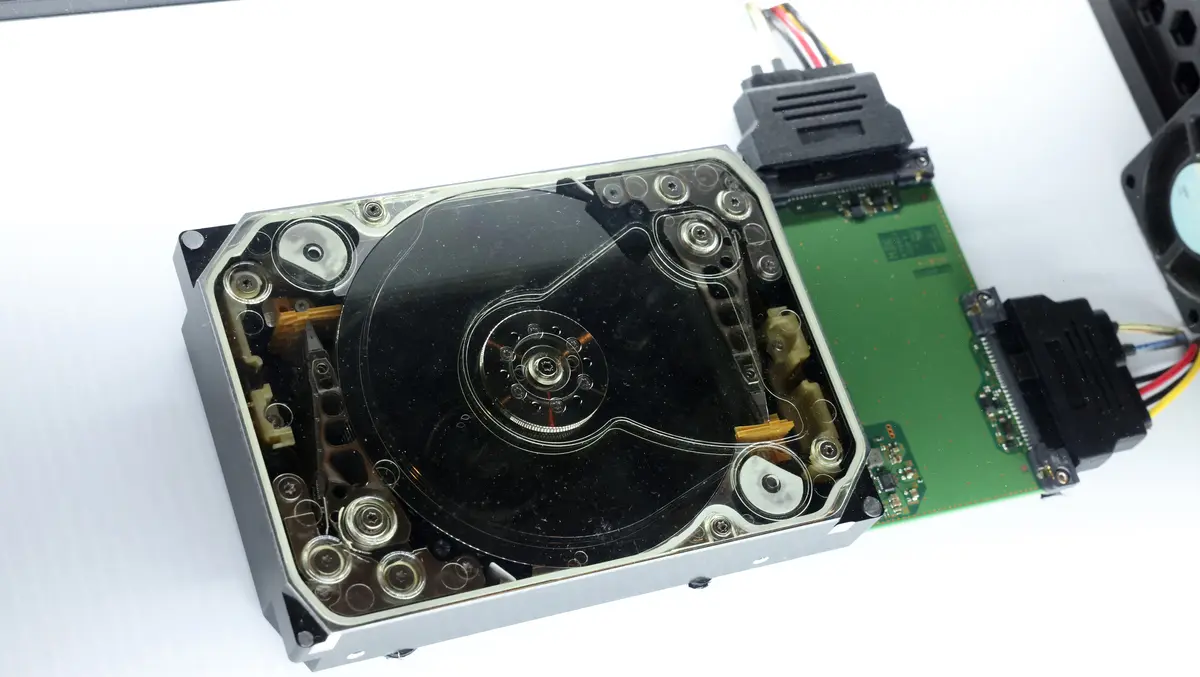
WD also outlined a Dual Pivot design that adds a second set of independently operating actuators on a separate pivot inside a 3.5-inch drive. The company says this can deliver up to 2x sequential I/O gains and differs from earlier dual-actuator concepts by avoiding capacity trade-offs and minimising the need for customer software changes.
WD says Dual Pivot also reduces spacing between disks, increasing the number of platters per drive and raising capacity. Drives using Dual Pivot are currently in the lab, with availability planned for 2028.
Power Focus
Energy use has become a major constraint in large data centres, particularly where AI clusters compete with storage and networking for power and cooling. WD says it has designed a power-optimised hard drive architecture that uses 20% less power.
WD framed the design around "warm" and "cold" tiers, arguing that AI creates large volumes of cold data that still needs to be accessed quickly. This can force operators to choose between expensive solid-state storage and slower archival approaches.
According to WD, its power-optimised drives trade a small amount of random I/O for higher capacity and lower power draw, while keeping the 3.5-inch form factor common in existing data centre deployments. Customer qualification is expected in 2027.
Platform Layer
WD also described an expansion of its Platforms business, including an "intelligent software layer" with an open API planned for launch in 2027. The software is designed for organisations operating at 200 petabytes or more that face scaling pressures similar to hyperscalers but lack their engineering resources.
The company says the software will work across its UltraSMR, ePMR, and HAMR hard drives, as well as its flash products. The goal is to enable faster deployment and lower qualification risk across multiple storage tiers, without requiring changes to customer architectures.
In a statement on the roadmap, Irving Tan, WD's Chief Executive Officer, said: "For the past year, WD has remained continuously focused on execution and accelerating innovation, which has enabled us to truly reimagine the hard drive to meet the requirements of AI."
"Today, we are showcasing innovation that reflects our deep connection to our customers and how we are meeting demand for capacity, scale, quality, enhanced performance, and ease of technology adoption."
Ahmed Shihab, WD's Chief Product Officer, described the company's focus on AI infrastructure build-outs: "WD Innovation Day is where our customer-centric business transformation meets our breakthrough technology for the AI era."
Shihab added: "We've organised around how customers build and scale AI infrastructure. WD is challenging conventional storage assumptions and removing the complexity and cost barriers that limit their AI-driven growth. Our capacity, performance, power efficiency, and platform innovations solidify our position as the innovation partner for the AI-driven data economy."
IDC's Ed Burns, HDD Research Director, said: "WD's Innovation Day revealed a company that has genuinely transformed its strategy around customer infrastructure needs."
He added: "The market validation is already evident - customers are deploying these solutions because WD is solving what matters most for AI infrastructure: reliable capacity at scale, performance that meets demanding workloads, and economics that enable profitability. This customer-centric approach, combined with operational discipline, positions WD well in the market going forward."