


Half our data centres sit in two cities. That's neither sustainable nor resilient
Fri, 27th Nov 2026 (Today)
Councils from Sydney's north shore to Melbourne's west have asked for a pause on data centre approvals, and last week Whittlesea joined them. Grid works for NextDC's West Footscray campus are on hold until at least February 2027, and the Senate inquiry into data centres reports on 16 November. No government has paused approvals, but on the ground a pause has begun. It is time to ask where data centres should go.
Location is the sustainability and resilience decision
Location fixes most of a data centre's footprint. It decides whether power comes from congested city networks or from renewable energy that would otherwise be wasted, whether cooling draws on drinking water or recycled supply, and whether a campus sits beside homes. That is the sustainability test: environmental, social and economic outcomes weighed together. Location also decides resilience. When 80 per cent of operating capacity depends on two cities' networks, a natural disaster, major power failure or cyber incident in either becomes a national problem, as the Australian Strategic Policy Institute has warned.
Where Australia's data centres are
Data Centre Map lists 337 facilities across 34 markets (Figure 1). Of these, 288 are in capital cities and 170, half, in Sydney and Melbourne alone.
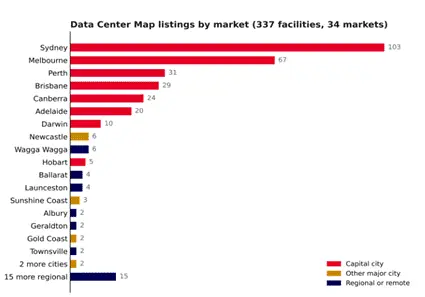
Figure 1. Data Centre Map listings by market
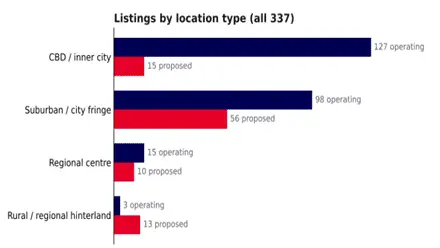
Figure 2: Data centre location by type
Nine in ten listings (295 of 337) sit in a CBD, inner city or suburban fringe (Figure 2). The industry's own forecast puts 94 per cent of operating and planned capacity in Sydney and Melbourne.
What makes a good site, and how ours measure up
A 2025 study in Renewable Energy rated locations on 34 sub-criteria under five criteria: environmental impact, accessibility, cost, social impact and renewable energy potential. The best combined strong wind and solar with infrastructure to connect them. Distance is no longer the barrier it was, round trips from regional NSW to Sydney take 3.4 to 6.8 milliseconds.
So what? Measured against those criteria, Australia's map is upside down. Nearly nine in ten listtings (296 of 337) sit in a CBD, inner city or suburban fringe (Figure 2), where clustering already congests the network and rain fall is declining. Meanwhile, regional NSW curtailed 29 per cent of its wind and solar output in 2025. This is both a sustainability cost intensifying competition for electricity and water and a resilience risk, concentrating critical digital infrastructure in two already-constrained metropolitan regions.
What researchers recommend
The Climate Council says renewable energy zones and former coal sites can host data centres where water is adequate. Australia lacks a coordinated national data-centre siting strategy, leaving around 50% of facilities concentrated in Sydney and Melbourne rather than strategically distributed to leverage opportunities across other regions (see figure 1). The federal consultation paper goes further, asking whether states should identify sites away from populated areas and whether data centres should keep a minimum distance from homes and schools. Projects are already testing the idea: Singapore proposes a 720-megawatt campus near Victoria's former Hazelwood power station, drawing on non-potable water from the old plant's infrastructure, and IREN has signed a transmission agreement for an 800-megawatt site at Bundey, South Australia, that needs no network upgrades.
This is not a case for shifting the burden to the bush. The Western Downs proposal in Queensland has drawn a petition of more than 21,000 signatures. Regional sites must avoid high-biodiversity areas, not worsen local water insecurity, and leave lasting benefits with their hosts.
Why it isn't happening
Three things keep the evidence on the shelf. Sites are judged one at a time, so no approval asks whether a better site exists. The city fringe is cheaper for operators, while others bear the costs of congested networks and drinking water. And the regional option is not ready to buy: developers cannot see connection costs or delivery dates.
The way forward
- Mandate an alternatives test. Projects above 100 megawatts should show why a metropolitan site beats a regional or renewable-zone option, using the criteria the research already applies.
- Publish a national siting map. Overlay renewable energy zones, curtailed generation, transmission and water stress. States should name ready precincts, with connection costs and dates, after consulting councils, Traditional Owners and communities.
- Make the right place the cheaper place. Reflect network and water costs in connection charges, and tie public support to independently assessed benefits.
- Build in resilience. Distance alone cannot guarantee quiet. Pair Victoria's 150-metre buffer with enforceable noise limits that capture low-frequency hum, cap diesel-generator use, and mandatory retrofits when existing facilities expand.
A pause can turn the boom from a bet on two cities into infrastructure that is sustainable and resilient by design. We know where the better places are. We should start building there.