

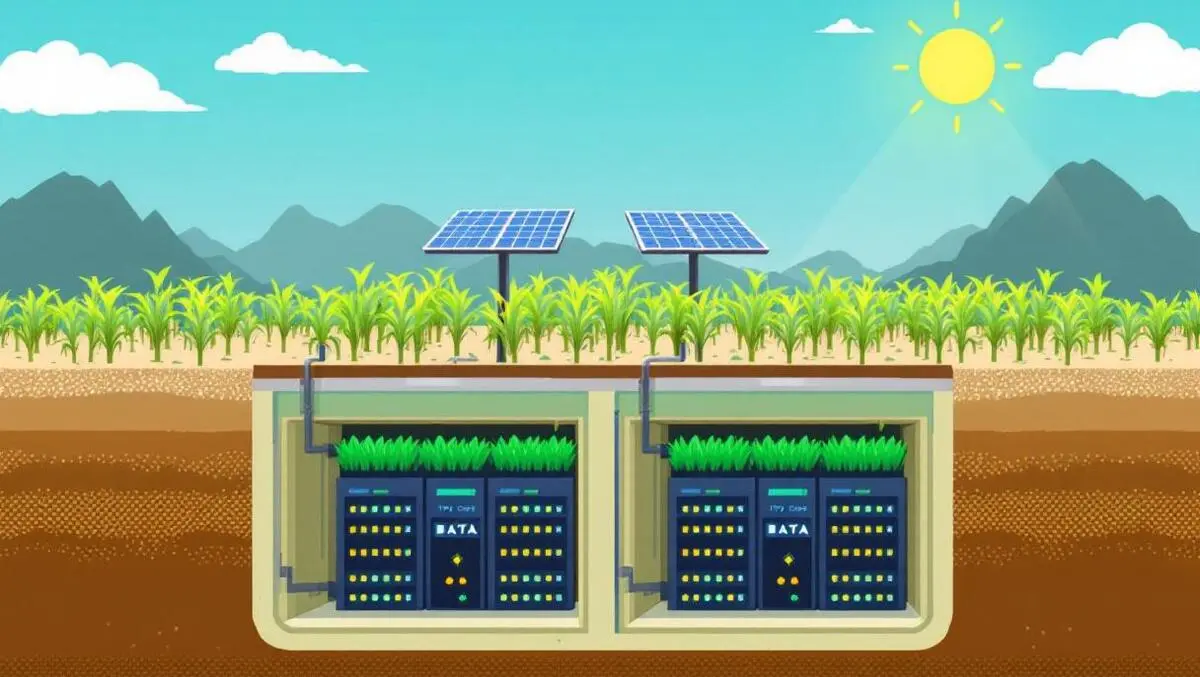
Data centres go underground with new sustainability plan
Fri, 21st Nov 2025
A new approach to digital infrastructure has been outlined by the Founder & CEO of Noteworthy Global, Hiran Daluwatta, combining data centres, renewable energy, and agriculture to address energy consumption, food security, and climate resilience.
The model, described as a Sustainable Integrated Data Farm, views the traditional data centre evolving into a multi-purpose system that supports technology, agriculture, and environmental targets.
Key points under this model include data centres becoming anchors of rural development, servers becoming sources of thermal energy for food systems, solar power becoming multi-use, and land becoming productive for digital, agricultural and energy production in one space.
"The future of digital infrastructure lies at the intersection of technology, agriculture, and renewable energy. By building underground data centres with agrovoltaics above, heat-to-food drying beside them, and solar-powered LN2 cooling integrated across the system, nations can turn the world's most energy-hungry facilities into regenerative, climate-positive assets," says Daluwatta. "This is not a distant vision but a blueprint that countries can deploy today to achieve net-zero targets, strengthen food resilience, and build the next generation of sustainable digital economies."
Underground deployment
The proposal advocates placing data centres underground. Daluwatta says this method would utilise natural insulation to reduce cooling energy use and stabilise internal temperatures, improving server performance and longevity. Underground positioning would also protect from natural disasters, fires, and physical threats, while eliminating competition for surface land.
Agrovoltaics and land use
The area above underground data centres is suggested for agrovoltaic systems. Here, solar panels would be arranged to allow crops to grow underneath. This setup produces electricity on-site while protecting crops from extreme weather. He says it could enhance water retention and create a dual income from electricity and agricultural produce.
Waste heat utilisation
Under this model, heat is redirected to solar-assisted food-drying and dehydration facilities. These units preserve surplus crops, reducing post-harvest losses and supporting local and export markets. It establishes a cycle where digital sector byproducts directly support food production and waste reduction.
Solar-powered cooling
The proposal would also replace traditional data centre chillers with liquid nitrogen (LN2) plants powered by on-site solar energy. The method is designed to be silent, vibration-free, and synthetic refrigerant-free, reducing reliance on the grid and enabling clean, scalable cooling suitable for hot climates.
Fully closed-loop system
Each component would be designed to work in tandem for maximum efficiency and output: solar energy powers both data centre operations and LN2 production; waste heat is recycled for food drying; crops grown above ground benefit from microclimate opportunities and return agricultural waste to the system as compost. Nitrogen released from the LN2 process re-enters the atmosphere, where it naturally occurs in high concentrations.
Local case studies
According to Daluwatta, this model is positioned as particularly relevant for Australia, the UK, and Singapore.
Each country faces specific challenges: Australia with heat and rural digital transformation, the UK with limited land and net-zero targets, and Singapore with reliance on food imports and urban density. The combination of underground data processing, surface-level agriculture, and solar integration addresses these varied requirements.