

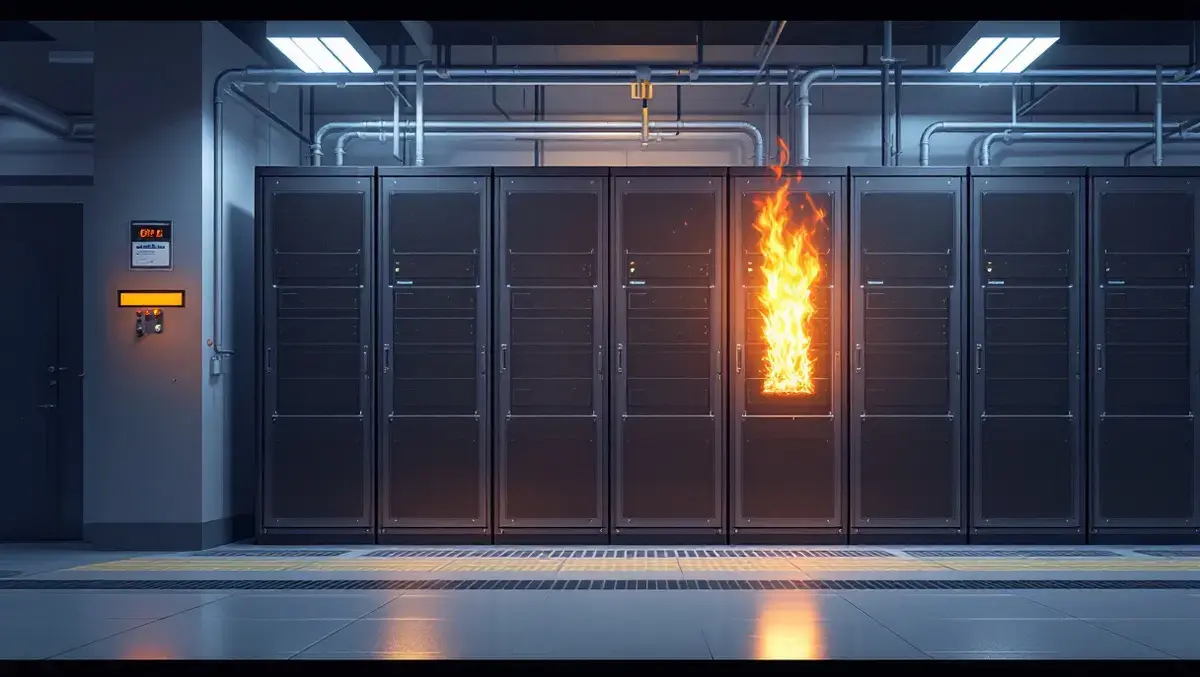
Ampace fire test shows UPS battery thermal runaway contained
Tue, 6th Oct 2026
Ampace has presented large-scale fire test results for its PU100 UPS battery system, showing thermal runaway remained confined to the initiating module.
Dr. Drew Feng presented the findings during a conference session in Singapore.
The test examined how a battery fire develops at installation level and whether it spreads to nearby equipment under defined conditions. According to Ampace, there was no propagation to adjacent modules or target cabinets, no sprinkler activation, and no re-ignition during a 24-hour observation period after the fire self-extinguished in about 40 minutes.
Ampace tested the PU100 in a layout intended to reflect dense data centre installations. The setup used a 3-metre ceiling height, zero side-by-side cabinet clearance, 20-millimetre back-to-back clearance, and 850-millimetre face-to-face clearance, with all cabinets at 100% state of charge.
Heaters initiated thermal runaway in the trigger module, which was then ignited to establish sustained combustion. The test monitored fire development, propagation, and sprinkler activation, followed by a re-ignition observation period and a post-test teardown.
Among the reported results, no burning debris escaped the cabinet. Ampace also reported a wall temperature rise below 80C and a ceiling steel beam temperature below 250C.
In a comparison presented during the session, the test met the large-scale fire test criteria assessed under the sixth edition of UL 9540A. Ampace also said several measurements remained below limits cited in that framework, including a wall temperature threshold of 97C and a ceiling steel beam threshold of 538C.
Standards focus
Dr. Feng's presentation examined installation-level large-scale fire test provisions in the sixth edition of UL 9540A. It also addressed how battery design and installation layout can influence the outcome of a severe fire event.
For data centre operators, fire safety assessments extend beyond the likelihood of an initial failure to the consequences if thermal runaway occurs. Large-scale fire testing is used to assess thermal exposure, fire spread, and the risk of re-ignition in realistic installation settings.
Ampace said the PU100 includes all-metal module and cabinet enclosures, ceramic thermal insulation in the modules, the high-voltage box and cabinet, and thermal barriers intended to limit fire propagation. The company positions the system for backup power applications linked to AI data centre workloads.
Post-test teardown findings were also presented during the session. According to Ampace, modules adjacent to the initiating module showed no thermal runaway and retained voltage readings of 53.2 V.
The initiating cabinet showed discolouration but no significant structural damage or collapse, the company said. It added that the adjacent cabinet retained its mechanical integrity and was reported to remain operational.
Industry role
Dr. Feng has worked on battery safety standards and is a voting member of UL technical committees. Ampace said he has contributed to the development of 19 UL standards, including UL 9540 and UL 9540A, which cover energy storage system safety and thermal runaway fire propagation testing.
In the presentation, Dr. Feng described the work as part of a wider need for evidence on installation-level battery safety. "LSFT for UPS Battery System: Last Key Piece toward Ultimate Safety," said Drew Feng, Ampace.
Ampace said it disclosed the test configuration, measured results, and teardown findings to give data centre operators and infrastructure partners more information for evaluating UPS battery fire safety. The 24-hour observation period extended beyond the 12-hour re-ignition period referenced in the session, and no sprinkler activation was recorded during the test.