

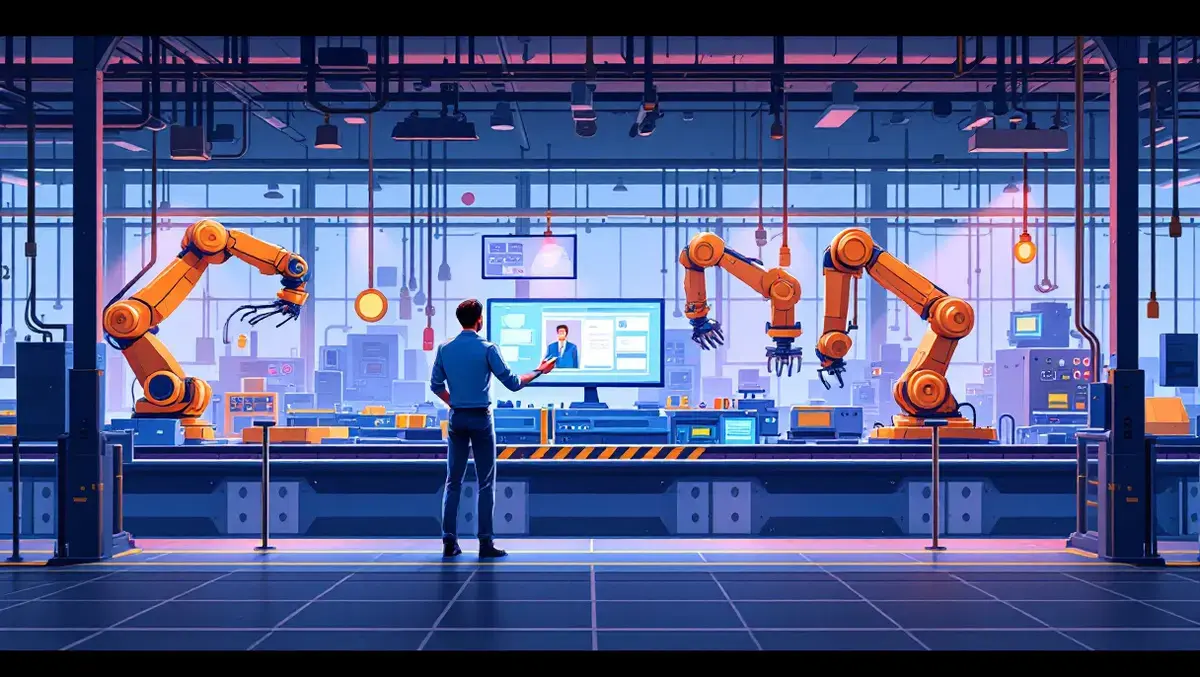
Industrial AI shifts from demos to tightly controlled use
Wed, 11th Nov 2026 (Today)
IoT Analytics has identified five trends shaping the next phase of industrial AI and AI infrastructure, based on technologies presented at NVIDIA GTC Berlin 2026.
The research argues that industrial AI is moving beyond demonstrations into limited deployments. But the assets needed to make those deployments work remain concentrated among software suppliers, manufacturers and data-centre operators. It highlights engineering solvers, plant and measurement data, and sites with grid access as the factors most likely to determine which projects progress.
Industrial agents
One of the clearest developments was the use of AI agents to operate industrial software rather than simply generate suggestions. IoT Analytics said Cadence and Dassault Systèmes presented agents that can plan tasks and run the vendors' engineering tools, while human engineers continue to review and approve the outputs.
This marks a shift from chat-style interfaces to systems that can take actions inside specialist industrial applications. Even so, the study indicates that these deployments remain tightly bounded, with people kept in the approval loop and operational freedom restricted.
IoT Analytics also identified a separation of security controls from the AI model itself. It highlighted NVIDIA's OpenShell runtime as an example of permissions being enforced outside the agent, while early factory agents shown by NVIDIA were limited to creating maintenance work orders rather than changing machine settings directly.
This reflects a broader concern in industrial settings, where AI systems must operate in environments built around deterministic processes and strict safety procedures. By limiting the scope of agent actions, vendors appear to be trying to balance automation with traceability and operational control.
Simulation and data
The report also points to a growing role for simulation in robotics training, but says real-world measurement remains decisive in judging whether systems will work reliably on the factory floor. It cites Lightwheel, which calibrated its robot simulation against measured robot forces and reported a 4.4% error on one cable-insertion task across five trials.
This suggests simulation can reduce development time and improve preparation before deployment, but it also underlines the commercial value of measurement data gathered from physical systems. In practice, manufacturers and robotics developers with access to high-quality operational data may hold an advantage over rivals relying mainly on synthetic environments.
Data-centre buildout
On AI infrastructure, the analysis identifies earlier site preparation as another significant shift. Data-centre deployment is being streamlined through two mechanisms: virtual validation to identify integration issues before hardware arrives, and prepared-site designs intended to reduce installation times once equipment is delivered.
For NVIDIA's DSX POD reference design, deployment at prepared sites could fall from six months to as little as 14 days, according to the report. It adds, however, that completed projects will be needed to assess whether faster deployment offsets potentially higher costs over the system's lifetime.
Power constraints emerged as a parallel issue. In a test involving Nscale, shared power headroom allowed 192 GPUs to operate instead of 140 under the same 264.4 kW provisioned limit, the analysis found. That lifted throughput by 49.2%, but it also increased measured power draw by 19.7% and pushed P99 time to first token up by 17%.
The figures illustrate the trade-offs facing operators trying to increase output within fixed energy limits. In Europe in particular, grid access could become a bottleneck for expansion in AI-focused industrial and data-centre projects, the report says.
Economic limits
Beyond the technical developments, IoT Analytics frames the next stage of industrial AI as an economic and operational challenge rather than simply a computing one. Expanding model use inside factories and engineering environments will depend not only on software design, but also on cost, integration effort, power availability and the ability to validate outcomes.
The report says factory operators are likely to broaden agent permissions only in stages, reflecting caution around reliability and safety. That gradual approach may slow adoption, but it also shows how industrial users differ from businesses deploying AI in less regulated or less physically constrained settings.
Satyajit Sinha, Senior Principal Analyst at IoT Analytics, said: "NVIDIA is addressing key AI bottlenecks, but more AI computing does not automatically create more industrial value. The central challenge is introducing probabilistic prediction technology into environments built around deterministic control, where AI decisions must meet strict requirements for reliability, safety and repeatability. Memory costs, power availability and integration complexity add economic constraints. Industrial AI's real test is whether it can deliver predictable, validated outcomes at a justifiable total cost. NVIDIA provides important building blocks, but closing this gap requires industrial software vendors, system integrators and manufacturers."