

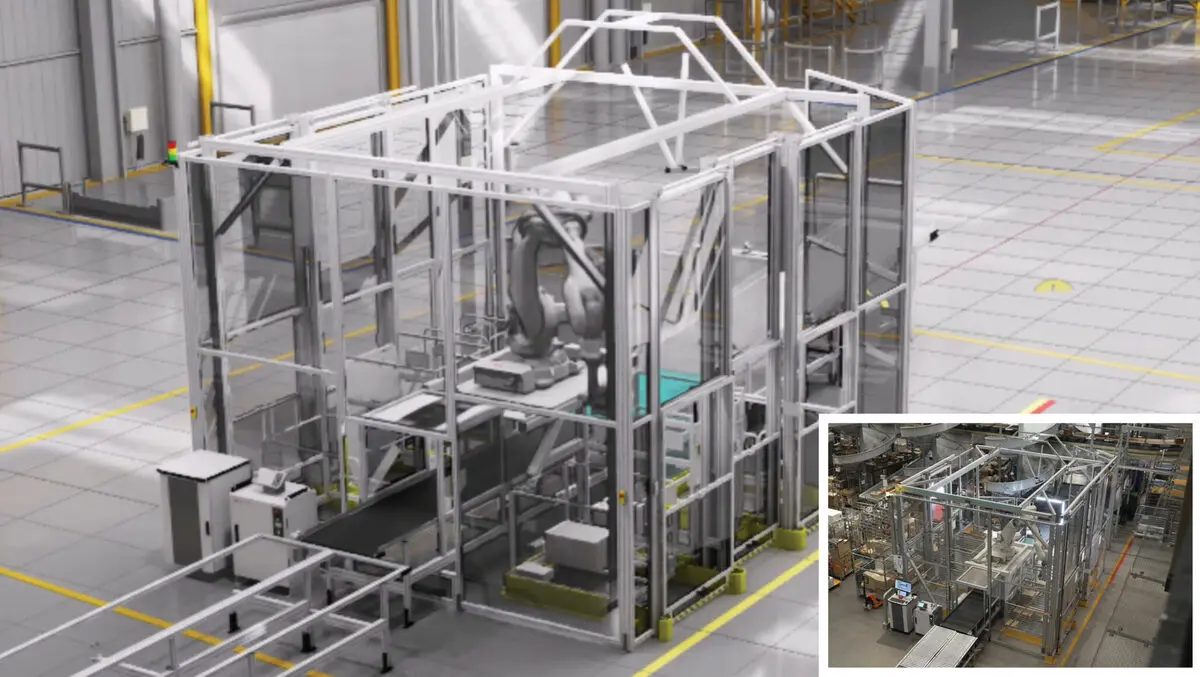

ABB Robotics has agreed a partnership with Nvidia to embed Omniverse simulation libraries into ABB's RobotStudio programming and simulation suite. A new product, RobotStudio HyperReality, is due in the second half of 2026.
The companies describe the integration as a step towards wider use of "physical AI" in industrial robotics. The goal is to strengthen the link between virtual commissioning and behaviour on the factory floor-often referred to as the sim-to-real gap.
RobotStudio update
RobotStudio is widely used for robot programming, cell design and offline simulation. ABB says more than 60,000 robotics engineers use the software.
Under the partnership, RobotStudio will gain access to Omniverse libraries for physics simulation and photorealistic scene generation. This moves more design and validation work into a digital environment before equipment arrives on site.
ABB calls the combined workflow RobotStudio HyperReality. ABB says it reduces engineering time, lowers deployment costs by up to 40%, and cuts time to market by as much as 50%.
Digital workflow
ABB describes HyperReality as a unified workflow for designing, programming, testing and validating an automation cell, allowing manufacturers to validate full cells before deploying a physical robot.
HyperReality exports a parameterised robot station into Omniverse as a USD file. ABB says the export includes robots, sensors, lighting, kinematics and parts.
In Omniverse, ABB's virtual controller runs the same firmware as the physical robot, according to the companies. ABB says this delivers 99% correlation between simulation and real-world behaviour.
The system can also generate synthetic images in Omniverse for AI training pipelines. ABB says this enables vision models to be trained entirely in simulation, reducing the need for large volumes of real-world image capture.
Accuracy claims
ABB also points to its Absolute Accuracy technology as part of the proposition, saying it reduces positioning errors from 8-15 mm to around 0.5 mm.
Manufacturers have long used simulation to plan and de-risk automation, but differences between virtual scenes and physical operations remain a limiting factor. Variations in lighting, material properties and real-world conditions can require extensive tuning during commissioning.
ABB argues that higher-fidelity simulation narrows these differences. It also says HyperReality can cut setup and commissioning times by up to 80% and, in some projects, remove the need for physical prototypes.
Factory pilots
Early pilots are under way ahead of the broader release. Participants include Foxconn and Workr, a US-based company that markets robotic workforce systems for small and medium-sized manufacturers.
Foxconn is piloting the technology in consumer electronics assembly, where frequent product changes and delicate components can make automation difficult. ABB says Foxconn is using synthetic data generated in the simulation environment to train robots before deploying them on production lines.
Workr is integrating its WorkrCore platform with ABB industrial robots trained on synthetic data created using Omniverse libraries. The companies say the aim is to shorten the time required to introduce new parts and processes in smaller factories, where engineering resources are often limited.
Controller roadmap
ABB is also exploring integration of Nvidia's Jetson edge AI platform into its Omnicore controller. The companies have not set a timetable or scope, but the work suggests a path to running AI inference closer to the robot in production environments.
The partnership reflects a broader push in industrial automation to combine simulation, synthetic data and AI models into a single workflow. Suppliers are seeking to reduce commissioning time and improve repeatability as factories add more sensors, more product variants and higher demands for traceability.
"Combining RobotStudio with the physically accurate simulation power of NVIDIA Omniverse libraries, we have closed technology's long-standing 'sim-to-real' gap - a huge milestone to deploying physical AI with industrial-grade precision, for real-world customer applications," said Marc Segura, President, ABB Robotics.
Nvidia framed the move as an adoption point for its simulation stack. "The industrial sector needs high-fidelity simulation to bridge the gap between virtual training and real-world deployment of AI-driven robotics at scale," said Deepu Talla.
RobotStudio HyperReality is scheduled for release in the second half of 2026, with customer pilots continuing ahead of general availability.