


Vertiv & Nvidia boost AI data centre design with DSX
Wed, 18th Mar 2026
Vertiv has expanded its work with Nvidia on physical infrastructure designs for AI data centres built around the Nvidia Vera Rubin DSX AI factory reference design and the Nvidia Omniverse DSX Blueprint.
The announcement focuses on what Vertiv calls converged physical infrastructure. Vertiv is supplying simulation-ready digital models for power and cooling equipment, along with validated interfaces and standard building blocks. The aim is to cut integration work and increase confidence in infrastructure designs before construction begins.
Rising rack densities and growing overall power demand are pushing operators to shorten deployment cycles and reduce execution risk. AI factory projects can involve many interdependent systems, including grid connection, power distribution, cooling and controls. Vertiv and Nvidia are therefore emphasising earlier system-level modelling and simulation.
Simulation models
Vertiv is contributing what it calls DSX SimReady digital power and cooling assets for use within the Vera Rubin DSX reference design and the Omniverse DSX Blueprint. The goal is to let designers simulate infrastructure behaviour and coordination before committing to a build-out.
Real-time simulation and system-level modelling sit at the centre of the collaboration, spanning power, cooling and controls. The scope runs from grid connection through to heat management near the chips, with heat reuse also flagged as part of broader thermal planning.
Vertiv defines converged physical infrastructure as a system-level model that integrates power, cooling, controls and services, treating them as interdependent rather than separate workstreams. The approach includes defined interfaces, repeatable design patterns, and digital continuity with lifecycle support.
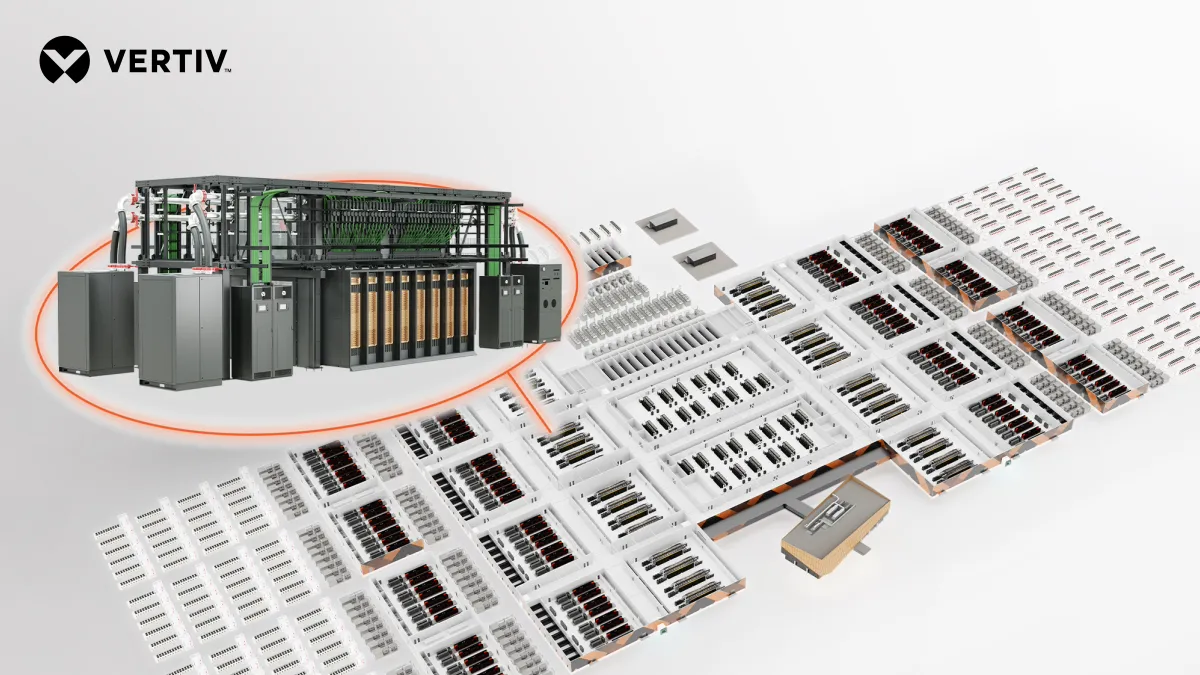
Building blocks
A core element is a standardised block architecture based on 12.5MW infrastructure blocks drawn from Vertiv's OneCore integrated modular solutions. Vertiv describes these blocks as units that can be combined and configured for deployments ranging from smaller AI clusters to gigawatt-scale sites.
Repeatable blocks and validated interfaces are intended to standardise parts of the deployment, reduce variation between builds, simplify scaling decisions and cut the effort of integrating multiple vendors and subsystems on site.
Vertiv highlights five elements in its approach: repeatable building blocks, defined interfaces, system orchestration, digital continuity and lifecycle support. It says the combination strengthens coordination across infrastructure domains from initial design through deployment and operation.
Scott Armul, Vertiv's Chief Product and Technology Officer, positioned the work within broader changes in data centre design practices.
"AI factories are forcing a fundamental change in how digital infrastructure is designed, validated, and deployed," said Scott Armul, Chief Product and Technology Officer, Vertiv.
He also pointed to an increased emphasis on system integration and modelling.
"Vertiv's role is to help turn complex AI infrastructure from a collection of separate products into converged, simulation-ready physical systems. Working with NVIDIA, we are helping customers move faster from design to deployment. By combining our power and cooling portfolio with validated interfaces and digital models, we can help customers accelerate development, improve operational confidence, and unlock better output per watt," Armul said.
Risk and readiness
The companies outlined several intended outcomes, including reduced deployment complexity and lower field integration risk, shorter time to operational readiness, and improved coordination between power, cooling and controls.
Vertiv contrasts converged physical infrastructure with conventional modular or prefabricated approaches, describing it as more than schedule compression. It expects system-level gains through standardisation and orchestration across the full power train and thermal chain.
Nvidia, which has promoted digital twin approaches through Omniverse, argues that integrating infrastructure models can reduce risk in large deployments.
"As AI factories scale to unprecedented levels of power and density, enterprises require a converged approach to physical infrastructure that unifies power, cooling, and digital twin simulation to reduce deployment risk," said Vladimir Troy, Vice President of AI Infrastructure, NVIDIA. "By integrating simulation-ready infrastructure models into the NVIDIA Vera Rubin DSX design, Vertiv is providing the repeatable building blocks and validated interfaces necessary to accelerate the path from design to operational readiness."
Vertiv is referring to the joint output as Vertiv OneCore Rubin DSX and says it will iterate the design for multiple future compute generations. It expects the work to influence future converged infrastructure offerings across hyperscale, colocation, enterprise and other AI deployment environments.