

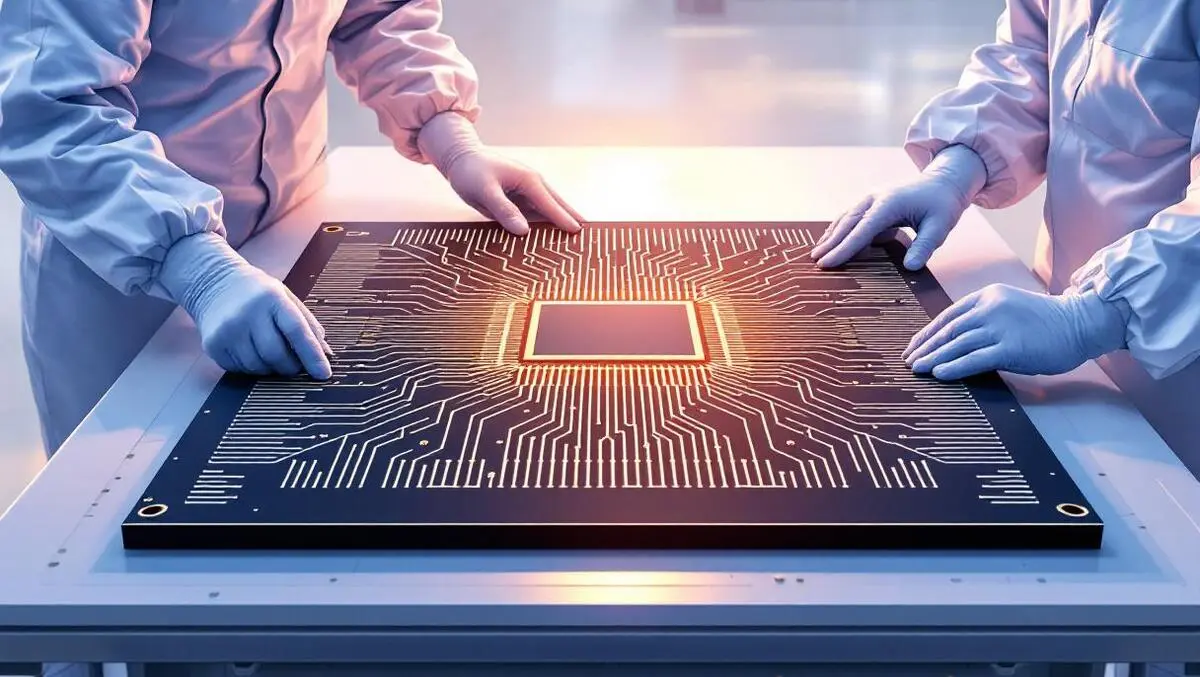
Quobly runs silicon-28 quantum wafers through ST fab
Fri, 12th Dec 2025
Quobly has begun running custom silicon isotopic wafers from Soitec through STMicroelectronics' 300 mm fabrication plant in Crolles, France, in a move that advances efforts to industrialise silicon-based quantum processors.
The wafers use fully depleted silicon-on-insulator, or FD-SOI, technology and are enriched with the silicon-28 isotope. The material is now in process development and validation at ST's high-volume facility.
The step links three parts of a developing European quantum hardware chain. Soitec supplies engineered substrates. ST applies its 300 mm manufacturing processes. Quobly designs and develops quantum devices on the platform.
Quobly positions the work as part of its roadmap towards quantum processor units with up to one million qubits. The company said the wafers represent a global first for FD-SOI substrates with a silicon-28 enriched channel.
The partners are targeting very high single-qubit gate fidelities. The wafers are engineered with reduced isotopic impurities, which the companies say cuts quantum noise.
Quobly said the approach aims at single-qubit gate fidelities approaching 99.999%. That level is seen in the industry as relevant for fault-tolerant quantum computing architectures.
Nicolas Daval, Chief Engineering Officer of Quobly, said the material marks an inflection point for the supply chain.
"The industrial availability of purified isotope 28 FD-SOI wafers is a game changer for quantum technologies. It allows us to anchor our developments in a solid and proven supply chain from purified gas to quantum chip delivery - a key enabler for achieving our quantum performance targets," said Nicolas Daval, Chief Engineering Officer of Quobly.
The first wafer lots are now running through ST's lines in Crolles. The process work draws on ST's existing 28 nm FD-SOI technology, which is used in conventional microelectronics.
The partners expect initial performance metrics from prototype quantum devices in the first quarter of 2026. These metrics will come from devices fabricated on the new substrates.
Quobly said FD-SOI offers a low-noise platform that is compatible with established CMOS processes. The silicon-28 enrichment sits in the transistor channel region on top of this platform.
The company aims to scale from millions of physical qubits on wafers to thousands of logical qubits in future quantum processors. The work relies on the existing infrastructure of the semiconductor industry.
Quobly said such processors would address applications in materials discovery, energy system optimisation and biotechnological modelling. These are areas where quantum simulation and optimisation are under active study by research groups and industry.
Engineered substrates
Soitec manufactures the 28Si FD-SOI substrates on its industrial production lines. The company specialises in engineered semiconductor materials that sit at the base of many advanced chips.
The new wafers use isotopically purified silicon. This reduces the presence of other silicon isotopes that can interact with qubits.
Christophe Maleville, Chief Technology Officer and Senior Executive VP Innovation of Soitec, said the project shows the firm's role in Europe's quantum plans.
"We are proud to see Soitec's advanced substrates contributing to the emergence of Europe's quantum ecosystem. This milestone illustrates how our expertise in engineering semiconductor materials can enable the next generation of quantum technologies", said Christophe Maleville, Chief Technology Officer, Senior Executive VP Innovation of Soitec.
STMicroelectronics hosts the wafers in its 300 mm line and runs the process development. The company brings experience in high-volume FD-SOI production for mainstream electronics.
Quobly focuses on device design and quantum operation. The firm develops silicon spin-qubit architectures on 300 mm wafers.
Quobly's growth plan
Quobly was founded in 2022 in Grenoble. The company builds on more than 15 years of joint research between CEA-Leti and CNRS in quantum physics and microelectronics.
It raised €19 million in 2023 in what it described as a record European seed round for a quantum hardware start-up. It followed this in 2025 with a further €21 million for its Q100T programme.
The Q100T programme targets fault-tolerant quantum computing based on silicon qubits. It defines Quobly's medium-term technology goals.
The firm has also expanded its geographic footprint in Asia-Pacific. It announced its incorporation in Singapore during the SWITCH Singapore event this year.
Quobly has formed a strategic partnership with the National Quantum Federated Foundry in Singapore. The collaboration focuses on cross-benchmarking and characterisation of 300 mm silicon qubit chip designs.
NQFF uses its cryogenic measurement infrastructure to test and refine Quobly's qubit designs. The measurements provide data on performance at the very low temperatures needed for quantum operation.
The company said these efforts in Europe and Asia fit into a single industrialisation roadmap. The next milestone is the publication of performance data from the Crolles prototypes in 2026.